Bitcoin Release Date
Bitcoin, the pioneering cryptocurrency, wasn’t launched with a grand ceremony or a marketing blitz. Its genesis was far more subtle and revolutionary, unfolding quietly online. The key date to remember is January 3, 2009. This is the day the Bitcoin genesis block, the very first block in the Bitcoin blockchain, was mined.
While January 3rd marks the creation of the blockchain itself, the story doesn’t begin there. Months prior, in October 2008, a whitepaper titled “Bitcoin: A Peer-to-Peer Electronic Cash System” was published under the pseudonym Satoshi Nakamoto. This document laid out the technical and philosophical underpinnings of Bitcoin, describing a decentralized digital currency system free from central control by governments or financial institutions. It was disseminated through a cryptography mailing list, generating initial interest among cypherpunks and cryptography enthusiasts.
The genesis block was more than just the first block. It contained within its code a hidden message: “The Times 03/Jan/2009 Chancellor on brink of second bailout for banks.” This subtle insertion served as a timestamp and a commentary on the then-ongoing global financial crisis. It underscored the core motivation behind Bitcoin’s creation: to provide an alternative financial system less vulnerable to the failures and interventions of traditional banking.
The mining of the genesis block was a solitary act. Satoshi Nakamoto, working alone or as part of a small, unknown team, initiated the network. This initial period was crucial for bootstrapping the Bitcoin ecosystem. For the first few days, Satoshi was the only miner on the network, setting the difficulty and ensuring the initial stability of the blockchain.
Six days later, on January 9, 2009, Bitcoin version 0.1 was released, marking the official software release. This allowed others to download the software, join the network, and begin mining or using Bitcoin. This release was significant because it opened the door for broader participation and the gradual decentralization of the network.
It’s important to distinguish between these dates. October 2008 saw the theoretical framework presented in the whitepaper. January 3, 2009, marked the instantiation of the blockchain. January 9, 2009, facilitated the practical adoption and expansion of the Bitcoin network.
While January 3rd is often cited as Bitcoin’s “birthday,” it’s more accurate to consider it the day the Bitcoin blockchain was born. The release of the software on January 9th arguably represents the beginning of Bitcoin’s life as a functioning, albeit nascent, cryptocurrency available to the wider world. These dates represent critical milestones in the unfolding narrative of Bitcoin, a narrative that continues to evolve and reshape the landscape of finance and technology.
 768×454 timeline bitcoins journey cnbctvcom from www.cnbctv18.com
 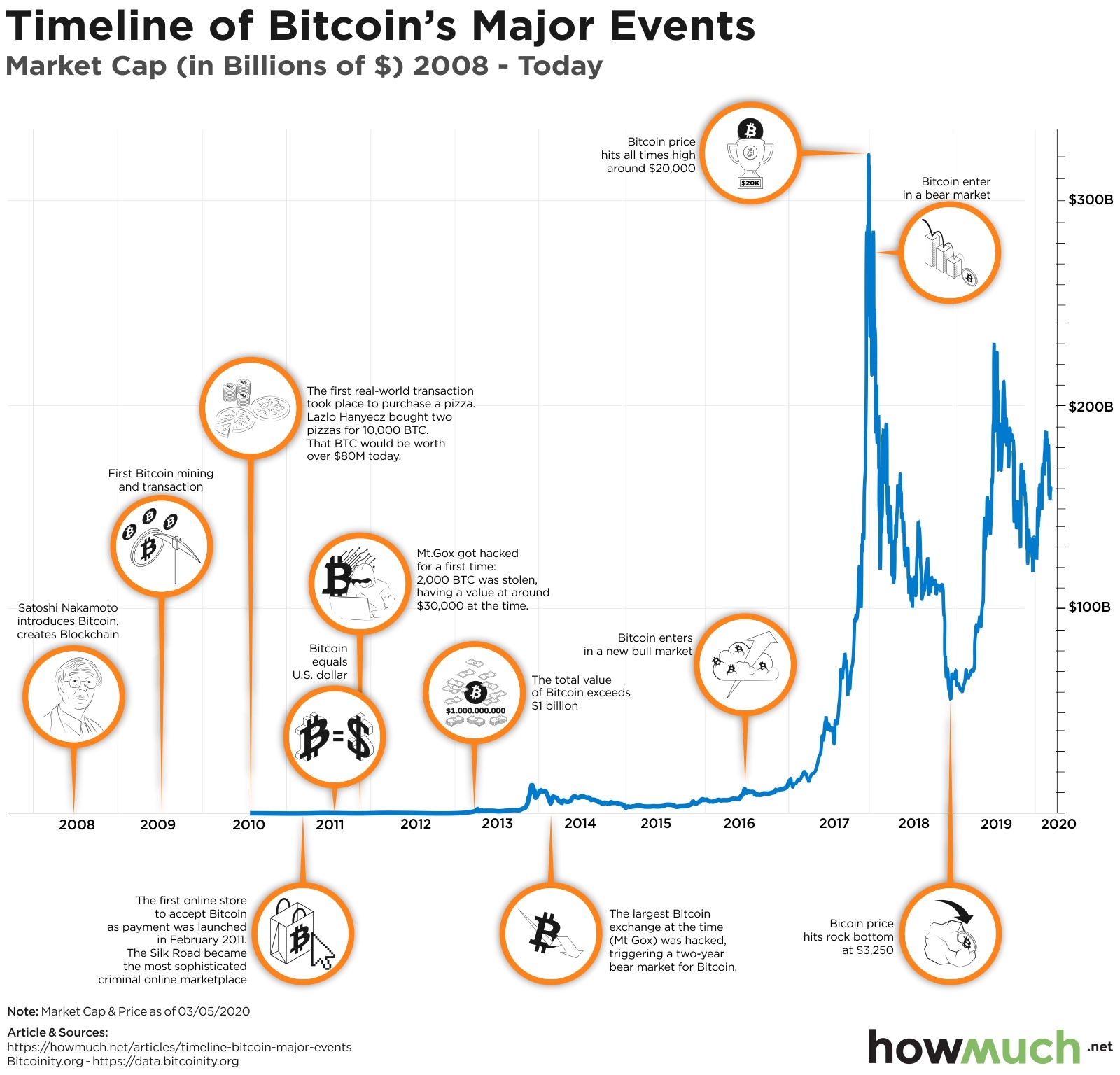 1600×1536 visualizing bitcoins wild ride decade from howmuch.net
  3018×1710 bitcoin timeline history bitcoin timeline from lionmuthucomics.blogspot.com
  1600×900 ten years bitcoins history altcoin buzz from www.altcoinbuzz.io
  3325×2200 exciting infographic shows evolution bitcoin merkle news from themerkle.com
  1200×630 year bitcoin arrived fullycrypto from fullycrypto.com
  1300×740 bitcoin price history infographics prices chart from www.alamy.com
  1440×564 infographic entire history bitcoin from fintechnews.hk