Bitcoin Address Check
Bitcoin Address Validation
A Bitcoin address is essentially a public key hash, used to receive Bitcoin transactions. Ensuring the validity of a Bitcoin address before initiating a transaction is crucial to prevent accidental loss of funds. Several methods exist to perform this address check, ranging from simple format validation to more complex checksum verification.
Address Formats
Bitcoin addresses come in various formats, each with specific characteristics. The most common are:
- Legacy (P2PKH): These addresses start with ‘1’ and are the oldest format. They are Base58Check encoded.
- SegWit (P2SH): These addresses start with ‘3’ and are also Base58Check encoded. They represent Pay-to-Script-Hash addresses, offering benefits like lower transaction fees under certain conditions.
- Bech32 (P2WPKH or P2WSH): These addresses start with ‘bc1’ for mainnet or ‘tb1’ for testnet. They are case-insensitive and offer more efficient use of block space. They use a modified Base32 encoding with a more robust checksum.
Validation Methods
Validating a Bitcoin address typically involves these steps:
- Prefix Check: The first character or characters of the address must match the expected prefix for the network and address type (e.g., ‘1’, ‘3’, ‘bc1’, ‘tb1’). This immediately rules out addresses intended for other cryptocurrencies or networks.
- Length Check: Bitcoin addresses have specific length requirements. Legacy and P2SH addresses are typically 26-35 characters long. Bech32 addresses can vary, but invalid lengths are easily detected.
- Character Set Check: Legacy and P2SH addresses utilize Base58Check encoding, which uses a specific set of alphanumeric characters (excluding 0, O, I, and l to avoid ambiguity). Bech32 uses a different character set, a modified Base32. The validation must ensure that all characters in the address belong to the correct character set.
- Checksum Verification: This is the most important step. Base58Check and Bech32 encoding both include a checksum to detect errors.
- Base58Check: The checksum is calculated by hashing the address twice with SHA-256, taking the first four bytes of the second hash, and appending them to the address before encoding it in Base58. The validation process involves reversing this: decoding the Base58Check address, recalculating the checksum from the decoded data, and comparing it to the checksum embedded in the address. If they don’t match, the address is invalid.
- Bech32: Bech32 utilizes a different checksum algorithm. The address is processed through a mathematical function to calculate a specific checksum value. The validation process involves applying the same function to the address and comparing the result. Mismatches indicate an invalid address.
Tools and Libraries
Numerous online tools and programming libraries are available to validate Bitcoin addresses. Most Bitcoin wallets and exchanges automatically perform these checks before allowing users to send funds. Libraries in languages like Python (e.g., `bitcoinlib`), JavaScript, and others provide functions for Base58Check and Bech32 decoding and checksum verification, making it relatively easy to integrate address validation into applications.
Importance of Validation
Incorrectly entering a Bitcoin address can lead to irreversible loss of funds. A simple typo can result in sending Bitcoin to an address that is either invalid or controlled by someone else. Therefore, rigorously validating the address before sending any Bitcoin is paramount. Using readily available tools and libraries and understanding the different address formats are essential for safe and secure Bitcoin transactions.
 186×310 bitac bitcoin address checker easy quick check from fossdroid.com
 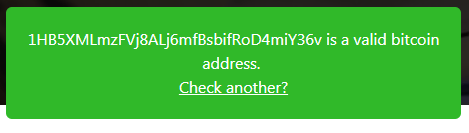 469×133 check bitcoin address valid cointools from cointools.org
  0 x 0 find bitcoin address blockchaininfo youtube from www.youtube.com
  954×1528 check bitcoin address valid earn bitcoin minutes from earnbitcoinevery5minutes1.blogspot.com
  708×852 bitcoin address bitcoin sense from bitcoinmakesense.com
  809×448 bitcoin address important from coinguides.org
  895×877 earn bitcoins guide bitcoin wallet address coinsph from earnbitcoinsguide.blogspot.com
  916×439 types bitcoin addresses from learn.hardblock.com.au
  803×1343 practical guide bitcoin addresses from bitcoinbriefly.com
  0 x 0 find bitcoin wallet address blockchaininfo youtube from www.youtube.com